


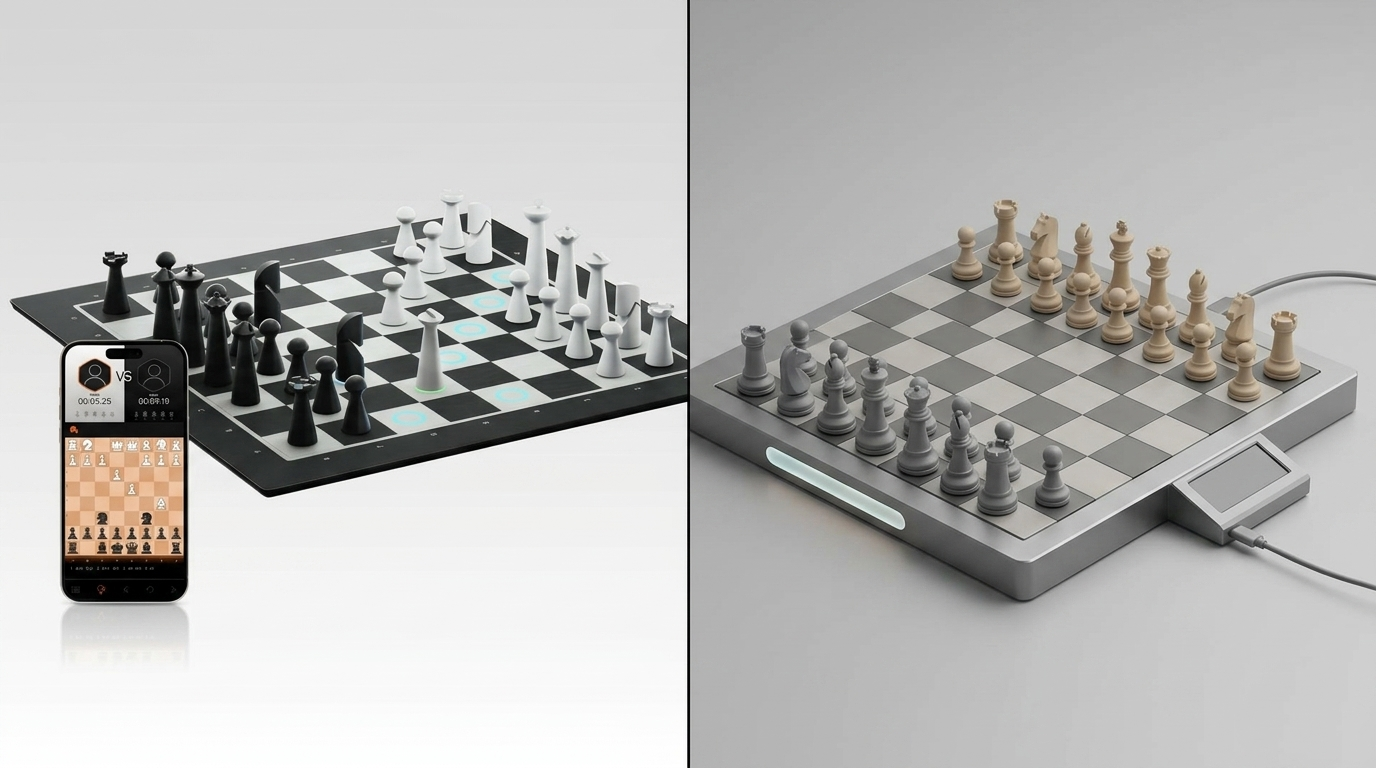
Updated July 2026. GoChess Lite Modern and ChessUp 2 are both coaching-oriented smart chess boards, but they put instruction in different places. This comparison uses official product details and prices checked on 2026-07-18. Particula makes GoChess; ChessUp 2 is made by Bryght Labs. Availability, prices, integrations, and software features can change after the check date.
Which teaches faster: GoChess or ChessUp 2?
Neither board can guarantee faster learning. GoChess Lite Modern gives feedback through real-time square lights and 32 AI levels, while ChessUp 2 combines guided feedback with a color touchscreen, lessons, and Stockfish. Choose the interface that makes the player complete another thoughtful practice session.
A chess board does not teach merely by being electronic. Progress still requires a loop: make a decision, receive understandable feedback, try again, and return often enough to notice patterns. The better teacher is therefore the board whose feedback the learner will consult without letting it make every decision for them.
GoChess keeps the visible intervention on the squares through legal-move, hint, and alert lights, with its companion app supporting the broader experience. ChessUp 2 makes a screen and lessons part of the board itself. That difference is more consequential than a generic “smart” label.
For a fair trial, use the same kind of position with both feedback styles in mind. Ask whether the learner wants an instruction written or displayed at the board, or whether a light on the relevant square is enough to prompt the next thought. The goal is not maximum assistance. It is feedback that arrives clearly and then leaves room for the player to calculate.

What is the biggest difference in the coaching experience?
GoChess emphasizes illuminated guidance on the playing surface and app-connected modes; ChessUp 2 emphasizes a more self-contained color touchscreen, structured lessons, and Stockfish feedback. Particula makes GoChess, while ChessUp 2’s on-board interface is a genuine competing strength for learners who prefer information at the board.
The GoChess approach can suit a player who wants the board to remain visually close to ordinary chess: pieces move by hand and the lights communicate on the squares. It lists face-to-face, online, and AI modes, so coaching is one part of a broader play routine. It does not move pieces automatically.
ChessUp 2 asks the buyer to value its integrated display. Its official listing also identifies lessons and Stockfish feedback. For someone who enjoys working through an explicit on-board lesson path, that may reduce the need to look elsewhere for the next activity. For someone trying to keep screens out of the center of the board, the same feature may be less appealing.
GoChess’s face-to-face mode also matters when the board will be shared locally. A pair can still play physical chess, with the connected layer available for alerts or guidance. ChessUp 2’s screen can be an asset at that same table when both players welcome the extra display. Neither setup should be judged only from solo practice.
| Decision point | GoChess Lite Modern | ChessUp 2 |
|---|---|---|
| Primary coaching interface | Real-time lights for legal moves, hints, and alerts | Color touchscreen, lessons, and Stockfish feedback |
| Online support stated | Chess.com and Lichess compatibility | Official Chess.com support |
| AI and play details | 32 AI levels; face-to-face, online, and AI modes | Guided feedback and lessons |
| Battery detail | Verify the current official listing | Six hours listed |
| Price checked 2026-07-18 | $269.95 sale; $299.95 regular | $349.99 sale; $399.99 regular |
| Warranty detail in cited evidence | One year | Verify the current official listing |
How do the dated prices compare?
GoChess Lite Modern was $269.95 sale and $299.95 regular; ChessUp 2 was $349.99 sale and $399.99 regular as of 2026-07-18. The $80.04 difference between sale prices pays for a different interface proposition, not proof of a better learning result. Recheck both listings before ordering.
The GoChess listing includes 32 pieces plus two extra queens at its dated price and states a one-year warranty. The ChessUp 2 listing supports its screen, lesson, Chess.com, Stockfish, and six-hour battery claims. Each buyer should compare the current package rather than assuming that the difference in price maps directly to teaching quality.
Which board fits a beginner better?
GoChess fits a beginner who wants guidance expressed through board lights and values both Chess.com and Lichess compatibility. ChessUp 2 fits a beginner drawn to a built-in screen and structured lessons, especially if official Chess.com support is sufficient. The stronger fit depends on how the learner likes to receive feedback.
Before choosing, let the beginner see how each feedback style changes a move. Some learners respond well to an on-board display that explains the next step. Others want only enough light guidance to keep playing physically. Neither preference is more serious; the useful one is the preference that leads to independent decisions and repeat practice.
Experience level can change the answer over time. A new player may begin with more visible help and later want fewer interventions. Before paying for either board, check whether its verified coaching approach still sounds useful after the rules are familiar. A durable purchase should support the next stage of practice, not only the first successful setup.
Which board is better for online play?
GoChess has the broader named platform pair in this evidence: its official listing states compatibility with Chess.com and Lichess. ChessUp 2’s official strength is its Chess.com support. Choose according to the service the player actually uses, then recheck that integration and any device or account requirements on the current product page.
Do not reduce online play to a logo on the product page. Confirm that the intended platform remains supported, identify the connected device needed for the first session, and decide where the player wants feedback to appear. A Chess.com player can reasonably prefer either board for other reasons; a committed Lichess player has a clearer named compatibility signal from GoChess in the cited evidence.
Online support and coaching are separate decisions. A player may want the board mainly to bring online opponents back onto physical squares, then use analysis elsewhere. Another may want the board to guide solo practice first and online games second. Rank those jobs explicitly; otherwise a platform feature can overshadow the interaction the player will use most often.
What should you verify before choosing?
Make the deciding feature perform a teaching job before checkout. For GoChess, confirm that the current light guidance and required online service fit the learner's device. For ChessUp 2, confirm that the touchscreen lesson flow is still included as expected. Then recheck each price, warranty, box contents, and charging needs on its official page.
The final choice can be simple. Buy GoChess Lite Modern when square lights, 32 AI levels, both named online platforms, and its lower checked price form the better routine. Buy ChessUp 2 when the color touchscreen and lessons are the reason the learner will sit down again. Choose neither if a conventional board and an existing app already cover the same need.
Official sources: Particula’s GoChess Lite Modern listing and Bryght Labs’ ChessUp 2 listing. Product details and prices above were checked on 2026-07-18.
Smart dice at a real table: battery, pairing limits, and durability
GoChess vs Chessnut Air: Chess.com and Lichess integration compared