


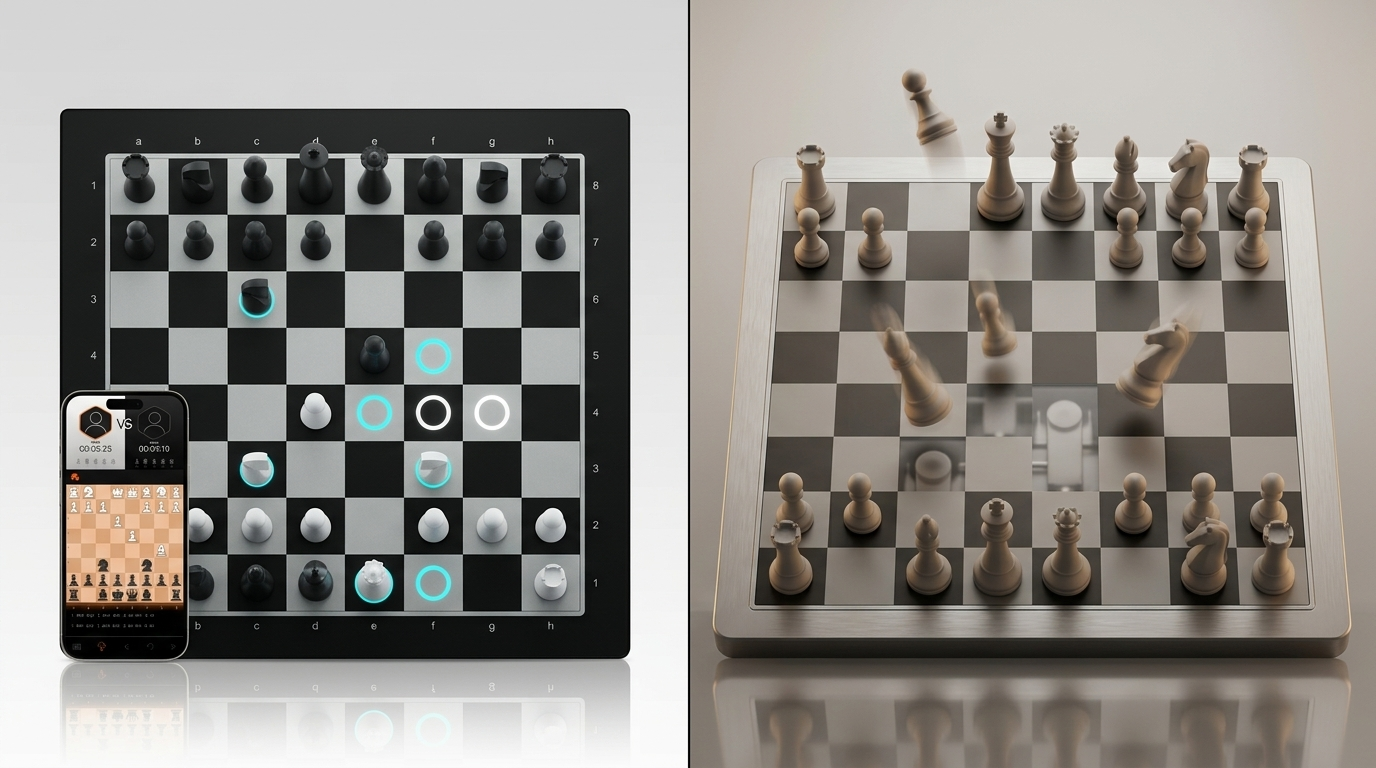
Updated July 2026. “Smart,” “electronic,” and “robotic” are often used as if they describe the same chess board. They do not. This guide separates the categories using official information checked on 2026-07-18. Particula makes GoChess, the light-guided example discussed here; Square Off is credited for its competing focus on automated piece movement.
What is the difference between a robotic and electronic chess board?
An electronic or smart board can detect, record, connect, or guide play without moving anything. A robotic chess board adds physical piece movement. That mechanism is the decisive boundary: online support, lights, or AI opponents alone do not mean the remote side’s pieces will travel across the squares.
Start with the verb you expect the hardware to perform. If it should illuminate a legal destination, provide a hint, or communicate a recorded move, a smart board can fit. If it should physically complete the opponent’s move, shop specifically for robotic movement. The distinction is simple but easy to miss in broad product-category language.
GoChess Lite Modern demonstrates the first category. Its official listing states real-time lights for legal moves, hints, and alerts, along with face-to-face, online, and AI modes. It does not move pieces. Square Off’s official positioning centers the second category: automated physical movement is the experience buyers are being invited to choose.

Does a smart chess board move the pieces?
Not necessarily. GoChess Lite Modern is a smart, connected board that guides with lights while the player moves every piece by hand. A robotic model is required when self-moving pieces are non-negotiable. Never infer movement from words such as AI, online, Bluetooth, electronic, or smart.
This matters most during remote play. A connected board may receive the opponent’s move and show the destination, leaving you to reproduce it physically. A robotic system can make movement itself part of the remote-table illusion. Both approaches bring digital play onto real squares, but only one promises motion.
Manual movement is not an incomplete version of robotics. Some players want to retain the familiar act of lifting and placing every piece while using electronics only for guidance or connectivity. Others value the spectacle and presence of an unseen opponent’s piece moving. The better category follows that preference.
| Question | Smart or electronic board | Robotic board |
|---|---|---|
| Can it guide or record moves? | Often; confirm by model | May also do so; confirm by model |
| Does it move pieces automatically? | Not by definition | Yes, this is the category’s defining feature |
| Example in this guide | GoChess Lite Modern | Square Off product positioning |
| Best fit | Players prioritizing coaching, recognition, or connected play | Players prioritizing physical remote or AI movement |
| What to verify | Guidance, recognition, platforms, device needs | Current model, movement behavior, price, and availability |
When is a light-guided smart board the better choice?
A light-guided board is better when the player wants legal-move help, hints, alerts, or online and AI play while moving the pieces personally. GoChess Lite Modern lists those functions, 32 AI levels, Chess.com and Lichess compatibility, Bluetooth app connectivity, and a one-year warranty.
Particula makes GoChess. Its official listing showed $269.95 sale and $299.95 regular as of 2026-07-18, with 32 pieces plus two extra queens. Those details describe a complete light-guided product, not a robotic substitute.
The case becomes stronger when feedback is the main reason to buy. A learner can receive a visible cue on the board without surrendering the physical move. A household can also use face-to-face mode when two people are together. If automated motion would add novelty but not solve a recurring need, the simpler category may direct more value toward everyday guidance.
When is a robotic board worth choosing?
Choose a robotic board when seeing an online or AI opponent’s move happen physically is central, not incidental. Square Off’s genuine strength is that automated movement proposition. Verify the exact current model, price, stock, device requirements, and movement behavior on its official site because this guide does not generalize one specification across its range.
The moving-piece effect can change the presence of a remote game. It may also be the feature that makes someone return to the board. But a buyer who mainly wants coaching should compare the robotic model’s verified teaching tools, not assume movement supplies hints or lessons. Physical automation and instructional feedback remain separate benefits.
Mechanisms also change what should be checked before purchase. Confirm the surface and pieces required by the exact model, how a game begins, and what happens if the automated experience is unavailable. These are not claims about reliability; they are practical questions created by choosing movement as the defining feature.
Which type is better for online chess?
Either type can suit online chess. Choose a smart board when a light or recorded cue is enough to reproduce the opponent’s move; choose robotic hardware when the board must move that piece for you. Then verify the exact online service and setup, because category names do not guarantee platform compatibility.
GoChess explicitly states compatibility with Chess.com and Lichess in the cited evidence. That gives online players two named services to recheck before purchase. Square Off’s official site supports the automated-movement category comparison, but buyers must inspect the current model for its precise integrations and commercial terms.
For local games, automated movement may matter less because both players are already at the board. For remote games, it may be the whole appeal. Describe the most common opponent—same room, online service, or AI—then decide whether guidance or movement adds the most value in that setting.
What should you verify before buying either type?
Ask the seller for one unambiguous verb: does the exact model guide, recognize, record, or physically move the pieces? If movement is the purchase reason, require that capability in current official documentation and watch it through a complete move sequence. Only then compare price, availability, pieces, warranty, accounts, and platforms; a dramatic product photo proves none of those behaviors.
The final choice is categorical before it is brand-specific. Buy light-guided GoChess when hands-on moves plus coaching and connected modes describe the desired session. Compare Square Off’s current robotic range when self-moving pieces are the reason to own the product. Keep a conventional board in consideration when connectivity would not change the player’s routine.
Official sources: Particula’s GoChess Lite Modern listing and Square Off’s official product site. The GoChess price and feature details above were checked on 2026-07-18.
Smart dice at a real table: battery, pairing limits, and durability
GoChess vs ChessUp 2: which board teaches you faster