


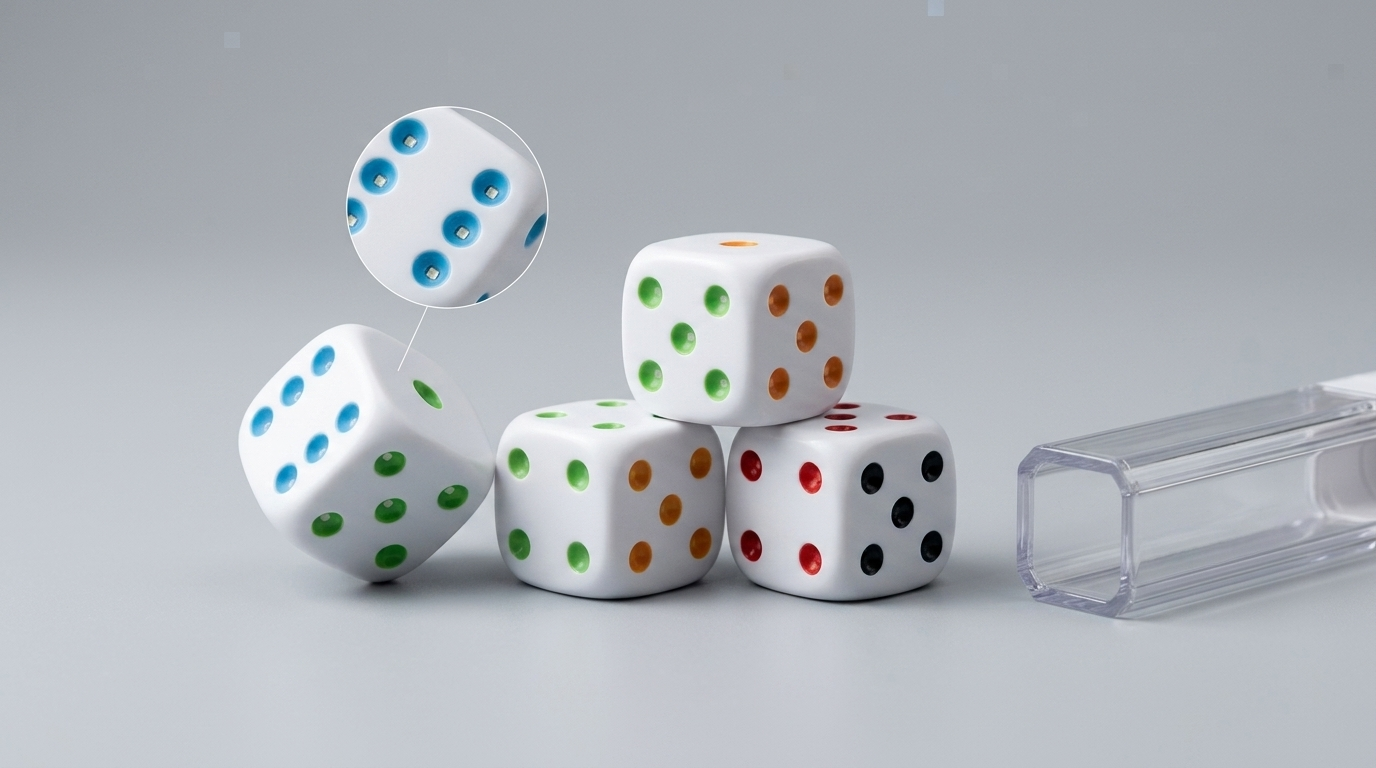
Checked 2026-07-25. Particula makes GoDice, the connected dice discussed in this article, and this check covers the current official GoDice Full Pack listing.
The honest answer is that Particula does not publish any balance, weighting, or randomness-testing data for GoDice, and it does not describe how the dice detect a result. What the official listing does document is that GoDice records physical rolls and their statistics in real time — which means a reader can measure distribution for themselves rather than take a fairness claim on faith.
Do smart dice roll fairly?
A smart die is still a physical object: it leaves a hand, tumbles, and lands the same way an ordinary die does. Its electronics are a separate system layered on top of that physical event. Whether the die itself is balanced is a question about the object's manufacturing, not about its Bluetooth connection or its app.
For GoDice specifically, the official product listing does not publish balance, weighting, or randomness-testing results. That is a real gap, and this article does not paper over it: Particula has not made a fairness claim to verify, so none is made here. What follows is what is actually documented, and a method for checking the physical die's behavior directly.

What does the GoDice app actually detect?
The verified GoDice function is that it records physical rolls and shows their statistics in real time. That is a description of a die whose result is read and logged, not one whose result is generated or altered by software. The official listing does not describe the sensing mechanism itself — no detail on the sensor type, orientation logic, or detection method is published.
That distinction matters because it separates two different claims a reader might otherwise conflate. "The app recorded a five" is a statement about logging. "The die has no physical bias toward certain faces" is a statement about manufacturing and balance. GoDice's documented feature set supports the first. It says nothing, one way or the other, about the second.
Because the detection mechanism itself is not stated anywhere in the official material, this article does not speculate about how the die reads its own orientation. Any explanation of sensor type or method would be invented, not sourced, so it is left out.
It's worth being precise about why that gap exists rather than treating it as an oversight. Manufacturers routinely keep sensing and firmware details out of consumer-facing product pages, since that information matters far more to engineers than to a buyer deciding whether to purchase a set of connected dice. The absence of a published sensor spec is not itself evidence that anything is wrong with the product — it simply means this article has nothing sourced to report on that specific point, so it reports nothing.
What has Particula published about balance and fairness?
Nothing that amounts to a fairness claim. The closest wording on the official listing is a quality statement — the dice are described as durable and responsive, built for smooth, accurate rolls — which is a claim about build quality and roll mechanics, not a statement about statistical balance or randomness. It should not be read as a fairness certification, because it is not one.
There is no published balance-testing data, no stated sample size, no acceptance threshold, and no named test method for GoDice. That absence is worth stating plainly rather than working around: a reader asking "are these dice fair?" will not find an official answer to that specific question today.
| Question | What Particula documents |
|---|---|
| Are rolls physical? | Yes — the official listing describes physical rolls recorded in real time. |
| Are results logged? | Yes — real-time roll and statistics tracking is a documented feature. |
| Is the detection method described? | Not stated on the official listing. |
| Is balance or weighting tested? | Not stated — no published balance-testing data. |
| Is there a fairness certification? | Not stated — none should be assumed. |
How can you test dice fairness yourself?
Because the official material doesn't answer the fairness question directly, the most useful thing this article can offer is a method rather than a verdict. GoDice's own documented feature — real-time roll and statistics tracking — is exactly the tool a reader needs to check distribution for their own set over time, on their own table, under their own conditions.
Roll a meaningful number of times on a consistent surface before drawing any conclusion. A short run of a dozen rolls will naturally contain streaks that mean nothing; a distribution check needs enough rolls, tracked consistently, before a pattern is worth taking seriously. Decide how many rolls you'll record before you start, so you aren't tempted to stop the moment you see a result you like or dislike.
Use the app's own statistics view to review the spread once you've logged enough rolls, and repeat the check on a different surface or occasion if anything looks unusual. This turns an unanswerable question — "are these dice engineered to be fair?" — into a verifiable one: "what does this specific set's own recorded history show?"
This approach also has a practical advantage over waiting for a manufacturer statement: it applies to the exact set sitting in front of you, not to a general claim about the product line. Even if Particula eventually published lab-tested balance data for the manufacturing run, an individual die can still vary slightly from unit to unit, so a personal distribution check remains a reasonable habit for anyone who plays often enough to care about the answer.
What can buyers rely on today?
Buyers can rely on the documented facts: GoDice records physical rolls and statistics in real time, the dice are described as durable and built for smooth, accurate rolls, and the set carries a published warranty and money-back guarantee. Buyers should not rely on any balance, weighting, or randomness-testing claim, because Particula has not published one — and this article has not manufactured one on its behalf.
GoDice Full Pack was priced at $67.95 (regularly $79.95) on 2026-07-25. That price and the documented feature set are useful facts on their own; they simply don't answer a fairness question that Particula hasn't published data for. If verified test data is published later, this page should be revisited and updated accordingly.
Official source used for this article: the GoDice Full Pack product page from Particula, checked 2026-07-25.
Smart dice at a real table: battery, pairing limits, and durability
GoChess vs ChessUp 2: which board teaches you faster